


Quality for capital markets
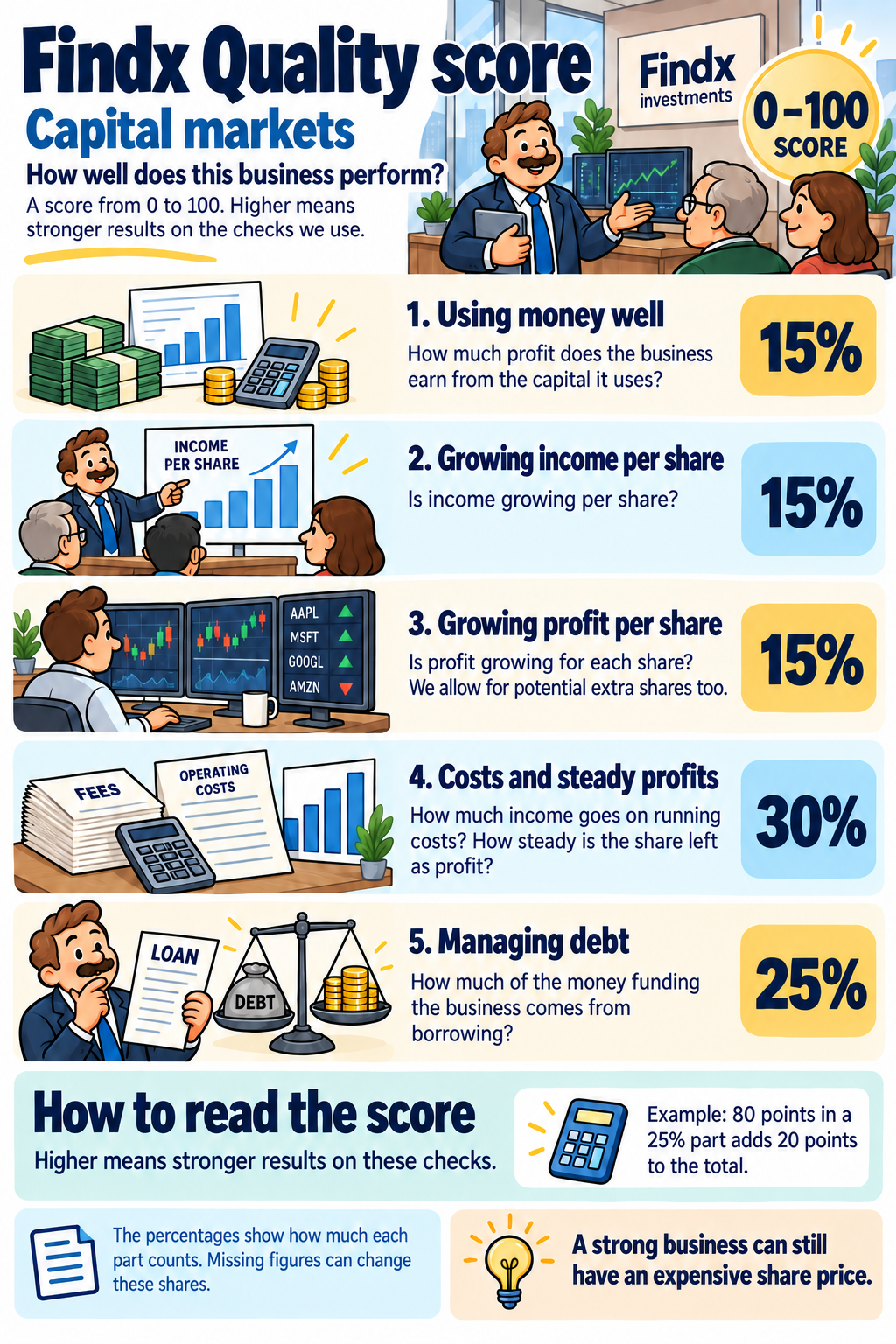
See how well this business uses money, earns profits and supports its finances. This guide covers businesses providing investment services. Quality checks growth in income per share rather than growth in lending income. How much profit does the business earn from the capital it uses? Is income growing per share? Is profit growing for each share? We allow for potential extra shares too. How much income goes on running costs? How steady is the share left as profit? How much of the money funding the business comes from borrowing? Each part receives points from 0 to 100. The percentages above show how much each part counts. A higher total means stronger results on these checks. Missing figures reduce the information supporting the score and may change how much each remaining check counts. With too little usable information, no score is shown. Read the notes beside the company’s score. A usable return measure is required. A strong business can still have an expensive share price. The score does not predict what the share price will do. These calculations apply to businesses such as money managers, payment providers and securities firms. Here, we give greater weight to costs and consistent profitability. A poor result and a missing figure are different things. A poor result lowers its part of the score. When a figure is missing, the other parts may receive more weight. We also show that the assessment is based on less information. We measure how much of the calculation has usable information. We use the component weights, so a missing measure with a large share matters more. At least 90% normally gives High confidence, 70% to below 90% gives Medium, and 60% to below 70% gives Limited. Confidence can be lower when some figures rely on an alternative calculation. We do not show an overall Quality score if usable information covers less than 60% of the calculation. We also need a usable return-on-capital measure. Without it, we do not show the score. For a bank, we use the corresponding bank return measure. A measure that is not used for that business type does not count as missing. For example, we do not assess a bank using the standard free cash flow calculation.The score in pictures
What we check
Using money well (15%)
Growing income per share (15%)
Growing profit per share (15%)
Costs and steady profits (30%)
Managing debt (25%)
How to read the score
How we calculate the points
Financial services and capital markets
What happens when figures are missing?