


Quality for property companies
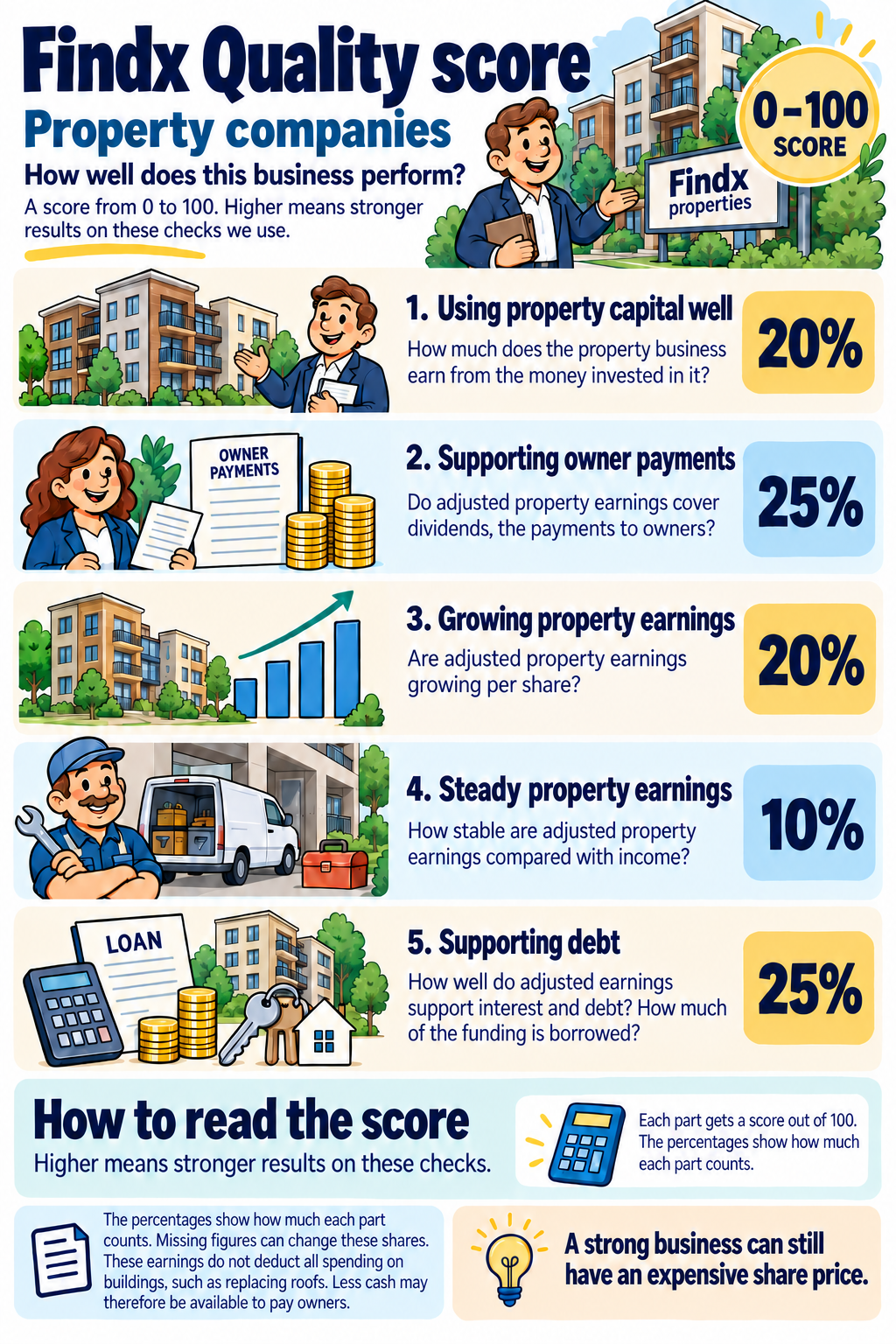
See how well this business uses money, earns profits and supports its finances. This guide uses adjusted property earnings, called FFO. The calculation adds back the gradual reduction in properties’ recorded value and adjusts certain other items. These earnings do not deduct all spending on buildings, such as replacing roofs. Less cash may therefore be available to pay owners. If these figures are unavailable, Findx uses the guide for most companies. How much does the property business earn from the money invested in it? Do adjusted property earnings cover dividends, the payments to owners? Are adjusted property earnings growing per share? How stable are adjusted property earnings compared with income? How well do adjusted earnings support interest and debt? How much of the funding is borrowed? Each part receives points from 0 to 100. The percentages above show how much each part counts. A higher total means stronger results on these checks. Missing figures reduce the information supporting the score and may change how much each remaining check counts. With too little usable information, no score is shown. Read the notes beside the company’s score. A usable return measure is required. A strong business can still have an expensive share price. The score does not predict what the share price will do. For property companies organised as REITs, we use an adjusted earnings measure called FFO. Among its adjustments, it adds back accounting depreciation on properties to profit. FFO helps assess property earnings, but it is not the same as cash available after all spending. If usable FFO figures are unavailable for a property company, we use the standard-company calculation. A poor result and a missing figure are different things. A poor result lowers its part of the score. When a figure is missing, the other parts may receive more weight. We also show that the assessment is based on less information. We measure how much of the calculation has usable information. We use the component weights, so a missing measure with a large share matters more. At least 90% normally gives High confidence, 70% to below 90% gives Medium, and 60% to below 70% gives Limited. Confidence can be lower when some figures rely on an alternative calculation. We do not show an overall Quality score if usable information covers less than 60% of the calculation. We also need a usable return-on-capital measure. Without it, we do not show the score. For a bank, we use the corresponding bank return measure. A measure that is not used for that business type does not count as missing. For example, we do not assess a bank using the standard free cash flow calculation.The score in pictures
What we check
Using property capital well (20%)
Supporting owner payments (25%)
Growing property earnings (20%)
Steady property earnings (10%)
Supporting debt (25%)
How to read the score
How we calculate the points
Real estate (REITs)
What happens when figures are missing?