


Understand the three scores
Findx helps you look for strong businesses at a price below their estimated fair value. Start by understanding the business. Then use the main chart to compare the share price with what the valuation model suggests it may be worth.
The three scores answer different questions. All run from 0 to 100, and none uses the share price. Open each explanation to see the measures, their shares of the score and the differences between company types.
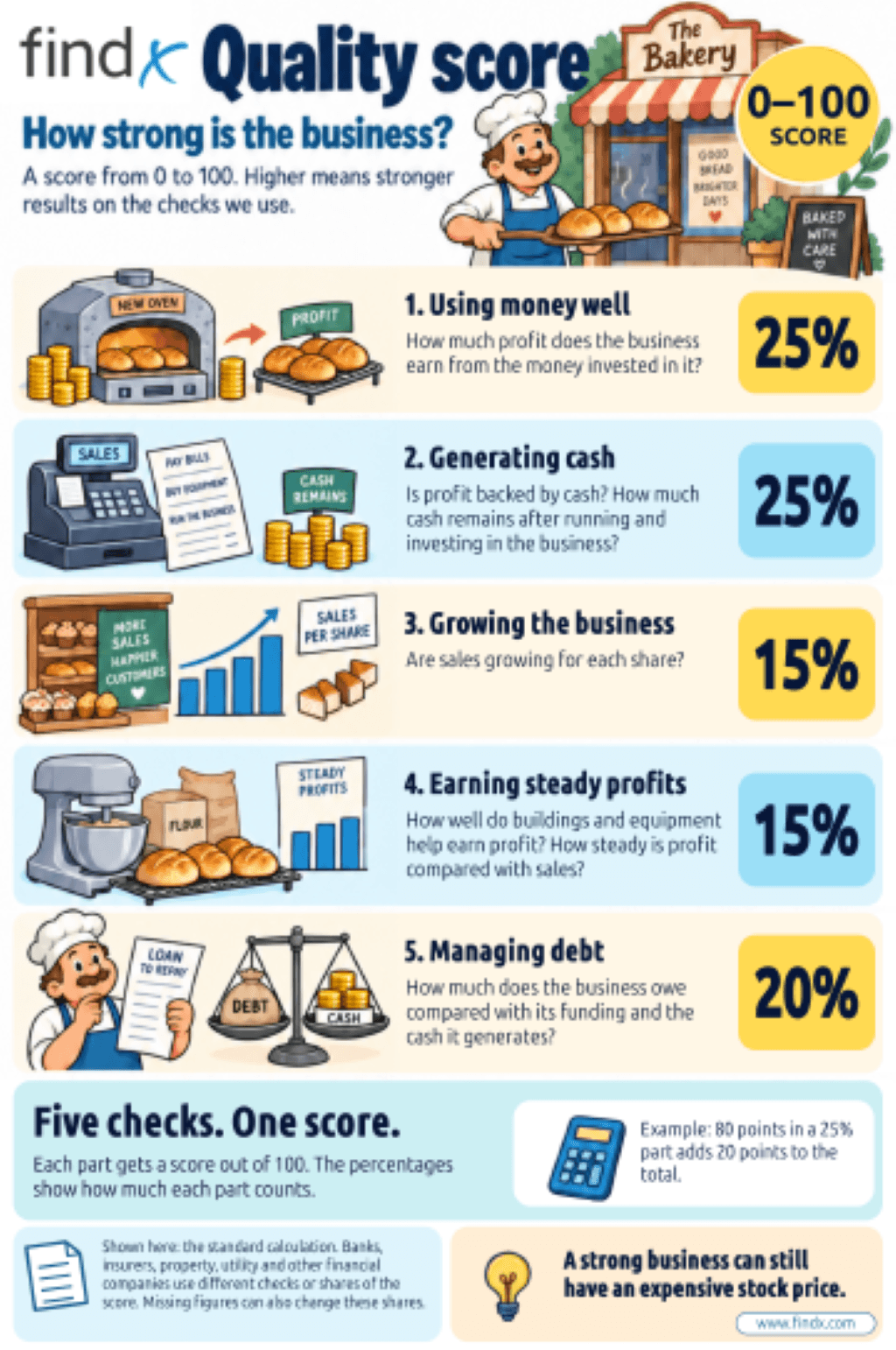 Quality
1. Quality: is it a strong business?
We look at how well the company uses its money, how much cash it generates, growth, steady profitability and debt. For ordinary companies, returns on capital and cash generation count most. A higher score means stronger measured business quality.
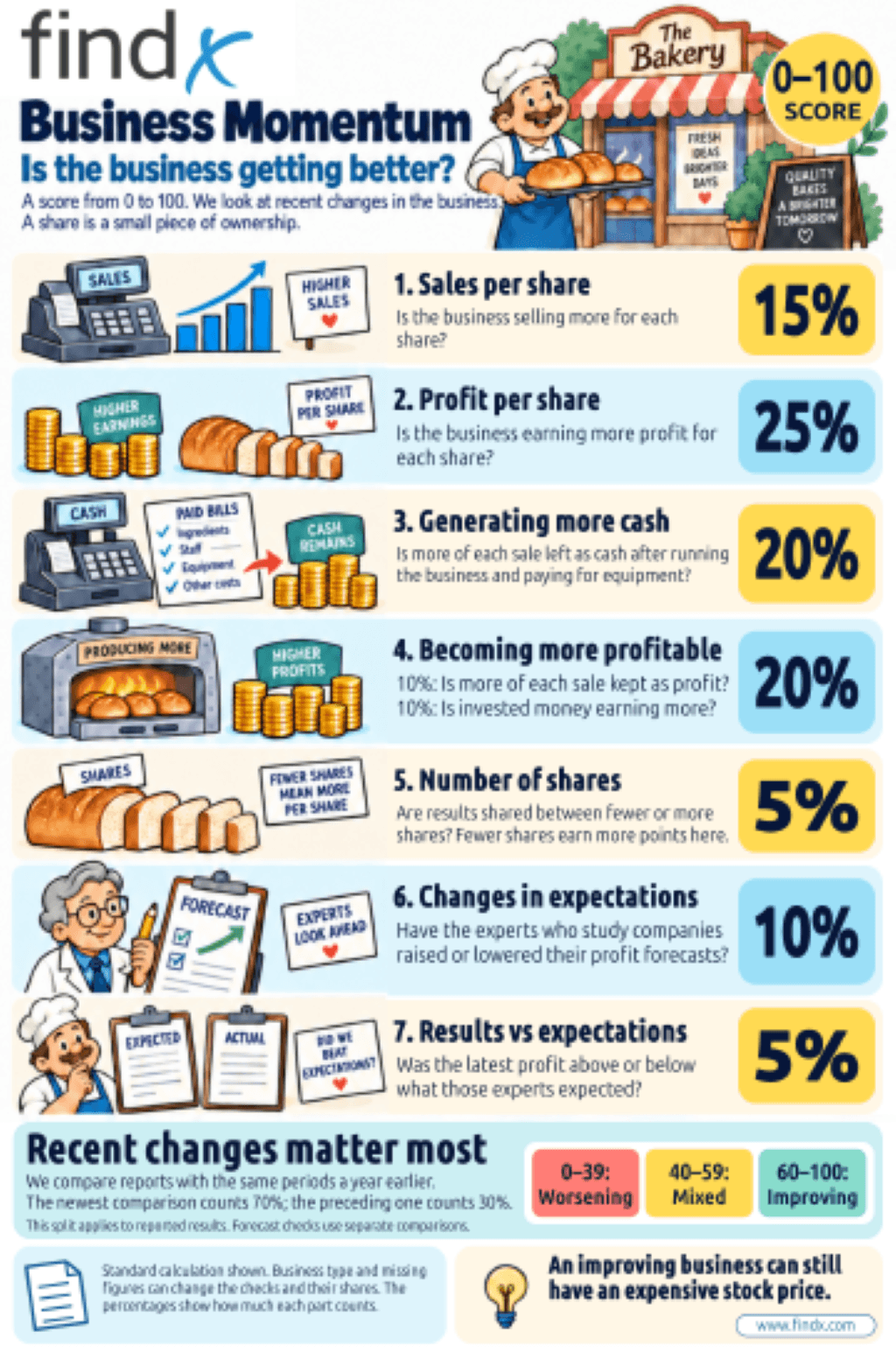 Business Momentum
2. Business Momentum: is it getting better?
We look at recent results and changes in analyst expectations. A score of 60 or more means improving, 40–59 means mixed and below 40 means deteriorating. A business can be strong overall while its latest results are weakening.
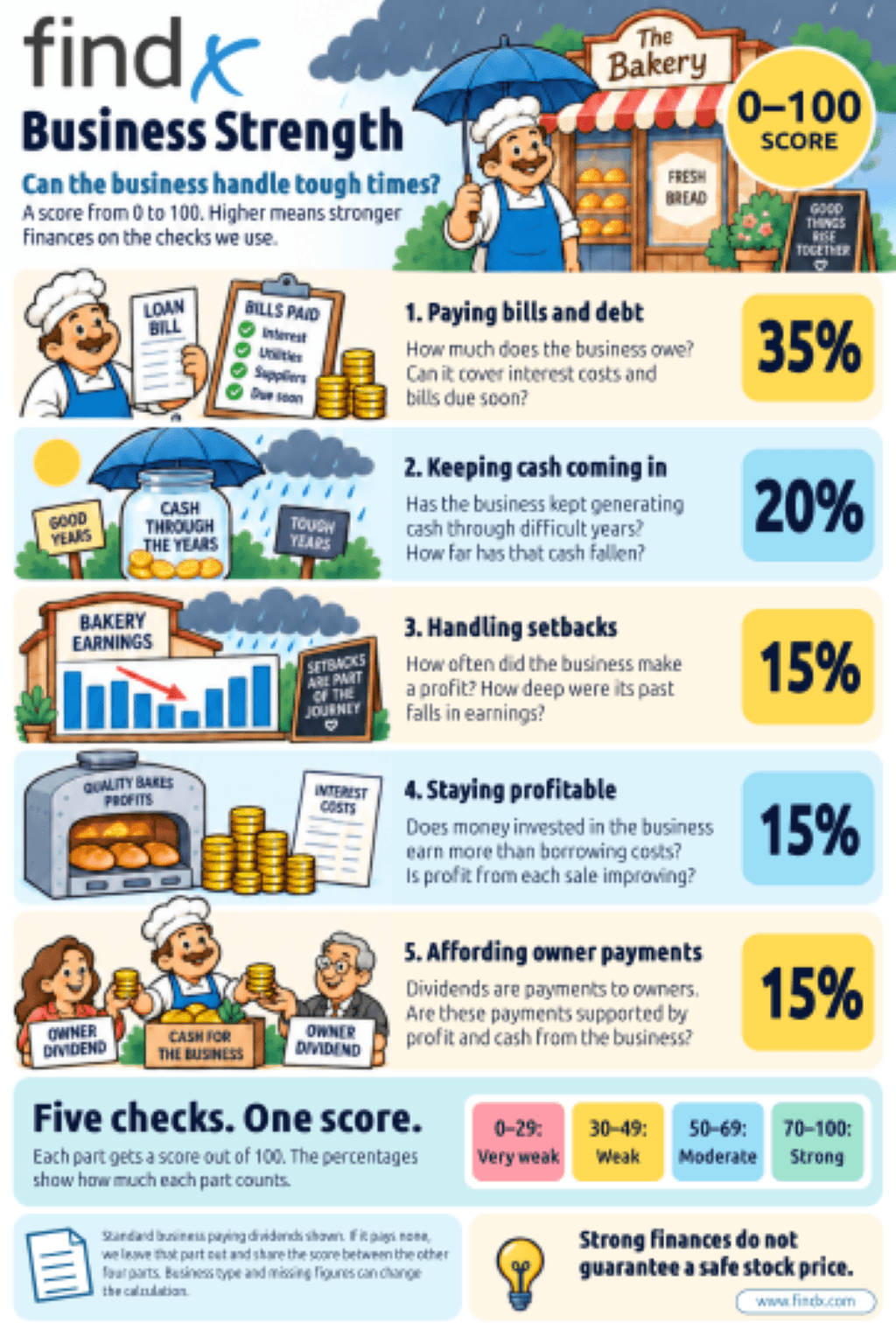 Strength
3. Strength: can it handle a difficult period?
We look at debt, past setbacks and dividend support. A higher Strength score means lower financial risk: 70–100 is Strong, 50–69 Moderate, 30–49 Weak and below 30 Very weak. The score describes the company's finances, not the chance that its share price will fall.
Use them together
High Quality and a high Strength score point to a strong business with financial resilience. Improving Business Momentum adds evidence that recent results are moving in the right direction. The next question is price: even a strong business can be expensive.
If a score is weak or a warning appears, open the details to understand why. Use the scores to focus your research on the parts that matter, then compare the share price with fair value on the chart.
Check the expected profit too
EPS means profit per share. The EPS estimates show what analysts expect the company to earn in future years. Check both whether they expect profits to grow and whether they have recently raised or lowered those forecasts. Those are two different questions.
Lower expected profits can reduce the estimated fair value. Understand the reason before treating a low share price as a bargain.
Scoring for each business type
The pictures above explain the method for most companies. Choose a business type below for its own illustrated guides.
- Most companies
- Banks
- Insurance companies
- Utility companies
- Property companies
- Financial services
- Capital markets